

Mandarin Season
Mandarins in season in Australia. Month-by-month availability by state, peak supply windows, growing regions and varieties.
When are Mandarins in Season?
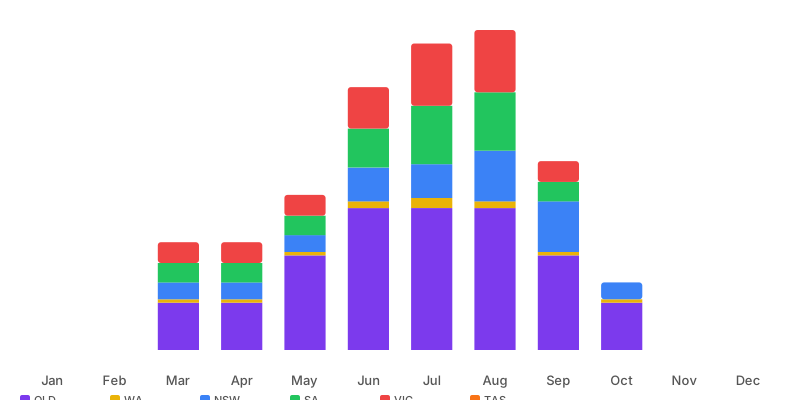
Mandarins are in season in Australia from April through to October, with the real peak between May and August. That's six solid months of good supply, and right now, in late autumn, Queensland's crop is hitting the shelves in full swing. The variety you're most likely to find first is Imperial, followed by Afourer through mid-winter, and Murcott carrying the season deep into spring.
When is Mandarin Season in Australia?
Mandarins are primarily a winter crop in Australia, with peak supply from June to August.
Mandarin trees take three to four years to first commercial crop. Growers need warm days and cool nights to develop colour and sweetness, and mandarins are harder to get consistently right than navels. Colour break, seed count and sugar-acid balance all shift with climate, rootstock and crop load. Afourer is particularly demanding. Trees can yield 60 to 90 tonnes per hectare in early years, but mature blocks need careful canopy management and fruit thinning to avoid alternate bearing, per NSW DPI. Murcott trees are prone to overcropping. Unchecked, the fruit weight can literally break branches, as the Citrus Australia Murcott fact sheet notes.
Mandarin Availability by Season
Mandarin Varieties
Imperial leads the early window from April, Afourer takes over through mid-winter with the deepest colour and highest juice content, and Murcott carries the crop into spring with brix levels that justify the harder peel.
Mandarin Varieties Through the Year
Imperial Mandarin Season
Imperial is Australia's best-known mandarin and, per Citrus Australia, the third-highest produced variety nationally. Queensland Imperials hit the market from April, peaking through May and June, with southern-grown fruit carrying to September. It originated as a chance hybrid at a NSW orchard around 1890, entirely home-grown. The traits that made it dominant for over a century are thin skin, easy peel, low seed count and a good sweet-tart balance. Ignore minor puffiness when selecting. Focus on weight relative to size.
Afourer Mandarin Season
Afourer is now Australia's highest-produced mandarin variety, per the Citrus Australia fact sheet. Deep red-orange, intensely juicy, easy to peel and holding well on the tree late in the season. It peaks June through July and can stay on the shelf into September. The variety originated as a chance seedling in Morocco (also known as Nadorcott or W. Murcott), entered Australian quarantine in the 1990s and was released commercially from 2000. Young blocks yield 60 to 90 tonnes per hectare, but managing canopy vigour and alternate bearing in mature orchards is an ongoing challenge in Sunraysia and the Riverina, as NSW DPI notes. Seed count is low to moderate depending on cross-pollination.
Murcott Mandarin Season
Murcott is Australia's second-most-produced mandarin and the late-season option that keeps the crop running into spring. Citrus Australia notes it peaks in July and stays available through to November in some regions, well after Imperial and Afourer have wound down. The Citrus Australia Murcott fact sheet puts juice content around 49%, with brix among the highest of any commercial mandarin, hence the Honey Murcott name. The trade-off is 10–20 seeds per fruit and a tight skin that can be harder to peel. The variety is believed to be a mandarin × sweet orange hybrid from a USDA Florida trial tree around 1922, introduced into Australia as illegal budwood in the early 1970s, then properly imported as seed in 1977. Queensland is the biggest producer, with significant volumes also from the Riverland, MIA and Riverina/Sunraysia.
Where do Mandarins Come From in Australia?
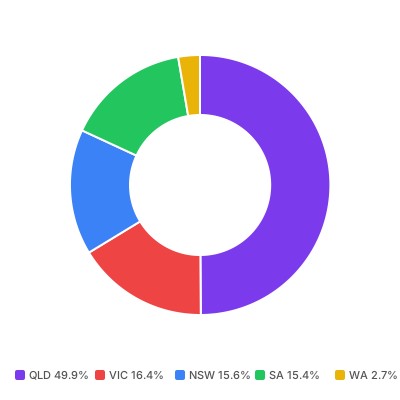
Queensland leads Australian mandarin production at around 50% of national output (120,019 tonnes in 2024/25), with Victoria (16.4%), NSW (15.6%) and South Australia (15.4%) roughly equal behind it. Main southern growing regions are the Murray Valley, the Riverina and the Riverland. Western Australia contributes 2.7%, from orchards north and south of Perth and around Kununurra, per DPIRD WA. The Imperial originated as a chance hybrid at a NSW orchard around 1890, entirely local. The Afourer, now Australia's highest-produced variety, is a Moroccan chance seedling that entered Australian quarantine in the 1990s and was first released to nurseries in 2000, according to the Citrus Australia Afourer fact sheet. The Murcott arrived as illegal budwood in the early 1970s and was properly imported as seed in 1977, per the Citrus Australia Murcott fact sheet.
Mandarin Production in Australia
Australian mandarin production has more than doubled in a decade. Hort Innovation puts the 2024/25 crop at 240,486 tonnes worth $456 million, up from 104,624 tonnes in 2014/15. Fresh mandarin exports reached 94,689 tonnes valued at $232 million in 2024/25, with South-East Asia as the primary destination. ABARES notes the combined orange and mandarin export value more than doubled from $235 million in 2009–10 to $520 million in 2019–20. Australia's April-to-October season aligns precisely with the northern hemisphere's off-season for fresh mandarins, which is the industry's key competitive advantage. Imports are negligible (under 1,000 tonnes a year by 2024/25), so virtually every mandarin you buy here is Australian-grown.