

Apple Season
Apples in season in Australia. Month-by-month availability by state, peak supply windows, growing regions and varieties.
When are Apples in Season?
Apples are available in Australia all year, with peak new-crop supply between March and June when fresh fruit comes in from Victoria, New South Wales and Tasmania. Cold storage and controlled-atmosphere rooms keep the major varieties on shelves through to the following autumn. The thinnest months are December and January, when storage stocks are running down and the new season hasn't started yet.
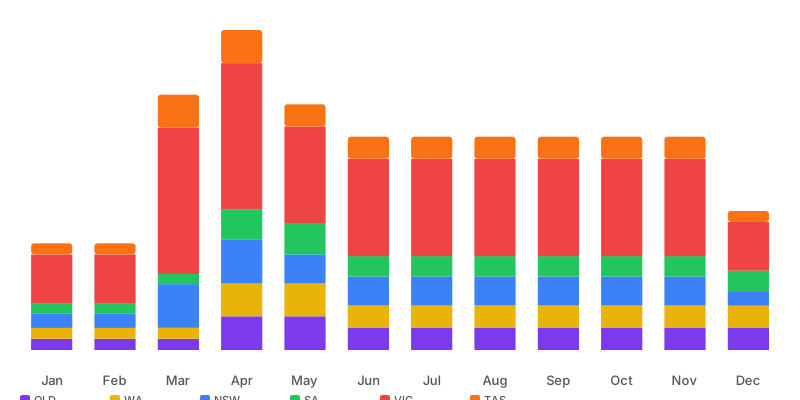
When is Apple Season in Australia?
Apples are in season year-round in Australia, with peak supply in autumn.
Modern apple orchards take three to four years from planting to first commercial crop, on dwarfing rootstocks in densely spaced rows for ground-level picking. Trees stay productive for 25 to 40 years. After harvest, apples go into standard cold storage at around 0°C or into controlled-atmosphere (CA) rooms where oxygen is dropped and CO₂ raised. CA-stored Pink Lady can stay firm and crisp through to the following winter, which is why a decent one is still on the shelf in September.
Apple Availability by Season
Apple Varieties
Royal Gala arrives first, typically from February, and doesn't hold long in storage. Pink Lady and Sundowner ripen latest, staying firm through controlled-atmosphere rooms well into the following year. Granny Smith and Pink Lady both trace back to Western Australian breeding programs, though the original Granny Smith was a NSW seedling from the 1860s.
Apple Varieties Through the Year
Granny Smith Apple Season
Granny Smith apple season peaks March to April and continues year-round through storage. The variety originated as a chance seedling at Maria Ann 'Granny' Smith's orchard in Eastwood, NSW, around 1868. Sharp-tart, bright green and very firm, it grows particularly well in Western Australia and is sought after on all state markets.
Pink Lady Apple Season
Pink Lady apple season peaks April to June with fresh new-crop fruit, then continues year-round through controlled-atmosphere storage. Bred by John Cripps at the WA Department of Agriculture's Stoneville research station from Golden Delicious crossed with Lady Williams, its underlying cultivar is Cripps Pink. The Pink Lady® trademark requires a licence to use. Late-ripening and needing a long warm season, it grows best in WA, NSW (especially Batlow), Victoria and South Australia, and is a strong export favourite into northern Europe.
Royal Gala Apple Season
Royal Gala apple season starts earliest of the major varieties, typically arriving in February and peaking through March and April. It originated in New Zealand in 1934 and is grown widely across Australia, especially in Batlow (NSW), Victoria and Western Australia. Sweet with low acidity and softer flesh than Pink Lady, it doesn't store as long. By spring, Royal Galas are usually past their best. Look for vivid red-orange striping. Dull colour signals storage fruit running out.
Sundowner Apple Season
Sundowner apple season peaks March to April, ripening latest of the major commercial varieties. From the same DAFWA breeding program as Pink Lady, Cripps Red is marketed as Sundowner® in Australia and Joya® in Europe. It shares Lady Williams × Golden Delicious parentage but is a different seedling selection. Deeper crimson-red and slightly milder than Pink Lady, still crisp and firm. Volumes are smaller than the big three, so it turns up mainly in late autumn and early winter when growers want to extend the new-crop window.
Where do Apples Come From in Australia?
Apples arrived with European settlers from 1788, and Australia's most significant contribution to world pomology came from a chance seedling at Maria Ann 'Granny' Smith's orchard in Eastwood, NSW, around 1868. Almost half of Australia's apples now come from Victoria (45.6% in 2024/25), mostly the Goulburn Valley. NSW (13.7%) centres on Batlow at around a thousand metres elevation. The remaining 40% splits between Queensland's Granite Belt around Stanthorpe (10.5%), Tasmania's Huon Valley (10.4%), WA's south-west around Manjimup (10.2%) and the Adelaide Hills (9.6%). Breeding programs ran from NSW (1930), Victoria (1947), Queensland (1964) and Western Australia (1972), with the last producing both Pink Lady and Sundowner.
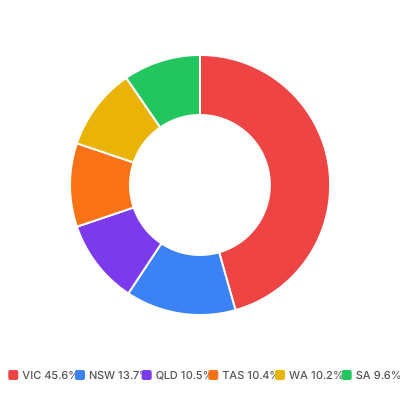
Apple Production in Australia
According to Hort Innovation, the Australian apple industry produced 295,691 tonnes worth $672 million in 2024/25, up in value from around $507 million in 2014/15 as growers have shifted to higher-priced varieties, even as tonnage has drifted slightly. CSIRO notes that around 84% of Australian households regularly buy apples and we eat about 10 kilograms each per year. Less than 2% of saleable apples are exported, with codling moth blocking access to many overseas markets, and fresh imports are negligible at under 1% due to quarantine restrictions.