

Banana Season
Bananas in season in Australia. Month-by-month availability by state, peak supply windows, growing regions and varieties.
When are Bananas in Season?
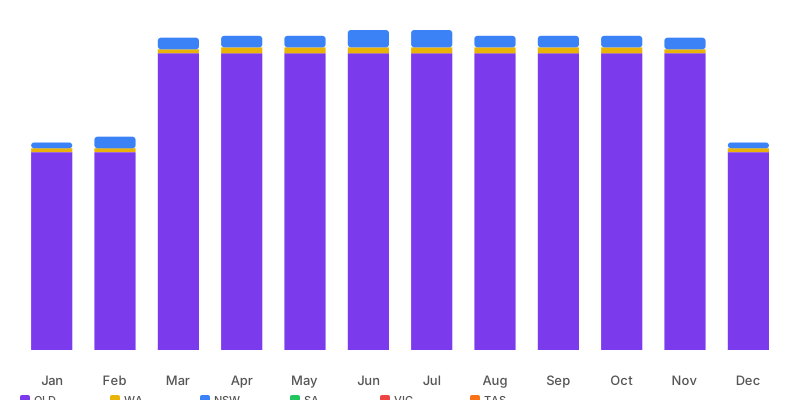
Bananas are available year-round in Australia, and unlike most fruit, there's no lean season. Production peaks between March and November, with Queensland's tropical north doing the heavy lifting. Every banana you buy here is Australian-grown. Fresh imports aren't permitted due to biosecurity rules that protect our farms from diseases such as Panama TR4 and banana freckle. The Cavendish is the one most of us know, though Lady Fingers have their own loyal following.
When is Banana Season in Australia?
Bananas are in season year-round in Australia, with peak supply in winter.
A banana plant takes around 12 months from planting to produce its first bunch, with subsequent bunches following every 8 to 10 months. Each bunch averages 150 to 200 bananas weighing 35 to 50 kilograms. As Australian Bananas explains, when a bunch is harvested the parent trunk is cut at head height, and the remaining section feeds the sucker plants at its base that produce the next crop. Bunches are picked green, transported at 14–16°C, and ripened in controlled ethylene rooms at distribution centres, producing the uniform yellow shelf fruit. A little extra time on the plant makes for a sweeter result.
Banana Availability by Season
Banana Varieties
Cavendish accounts for around 97% of Australian production and is available year-round. Lady Fingers are smaller, sweeter, genetically distinct as an AA diploid rather than Cavendish's AAA, and are grown mainly in northern NSW and subtropical Queensland, most reliably found at farmers markets and independent greengrocers.
Banana Varieties Through the Year
Cavendish Banana Season
Cavendish accounts for around 97% of Australian banana production, according to the Australian Banana Growers Council. It replaced the Gros Michel variety, wiped out globally by an earlier Panama disease strain in the mid-20th century, and is now itself under threat from Panama TR4, a soil-borne fungal disease first detected in Australia's Tully Valley in 2015. As a safeguard, QUT scientists developed the QCAV-4, the world's first GM banana, carrying a wild Musa gene that makes it nearly immune to TR4. It received Australian regulatory approval in 2024, as ABC News reported. Biosecurity controls have kept TR4 confined to a small number of properties, making QCAV-4 a backup option rather than an imminent replacement.
Lady Finger Banana Season
Lady Fingers are smaller and sweeter than Cavendish, with a honey-leaning flavour and thinner peel. The Australian Banana Growers Council puts them at around 3% of Australian production. They're more common at farmers markets and greengrocers than in supermarkets, grown mainly in northern NSW and subtropical Queensland for well over a century. They're an AA diploid, genetically distinct from the AAA Cavendish, and as Australian Bananas notes, they don't brown as quickly when cut. Wait until the skin is fully yellow with dark flecks before eating. An under-ripe Lady Finger is noticeably starchy.
Where do Bananas Come From in Australia?
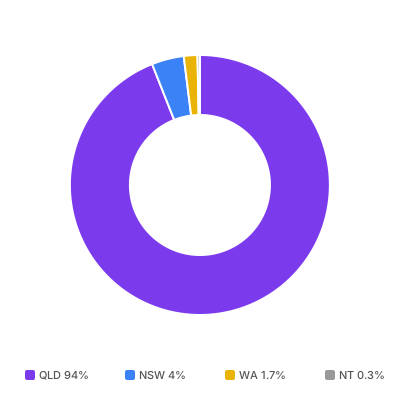
Bananas (Musa spp.) originated in Southeast Asia and Papua New Guinea and have been cultivated for thousands of years. The Australian Banana Growers Council notes that commercial production began in earnest in the late 1800s, with Chinese migrants establishing the first north Queensland plantations and Herman Reich planting large-scale orchards around Coffs Harbour in 1891. NSW led through much of the 20th century before north Queensland took over. Today Queensland accounts for 94% of production, centred on the Cassowary Coast (Tully, Innisfail, Kennedy), the Atherton Tablelands and Lakeland, with NSW at about 4% (Murwillumbah, the Tweed, Coffs Harbour to Stuart's Point). The Northern Territory has a modest and recovering industry after Panama TR4 and banana freckle set it back from the early 2000s.
Banana Production in Australia
According to DAFF, the Australian banana industry produced 368,701 tonnes valued at $719.4 million in 2024/25, with no fresh imports permitted due to biosecurity risk and only minimal exports. The Australian Banana Growers Council reports that more than 90% of households bought bananas in 2023/24 at around 13.5 kg per capita, and bananas held the highest share of fresh produce dollar sales (7.7%) in the 2022 NielsenIQ Top 20, roughly five million bananas consumed every day.