

Nashi Pear Season
Nashi Pears in season in Australia. Month-by-month availability by state, peak supply windows, growing regions and varieties.
When are Nashi Pears in Season?
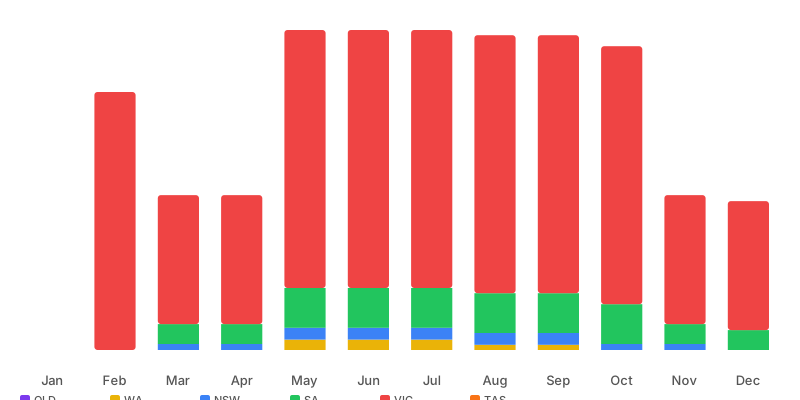
Nashi pears are in season in Australia from late summer through to mid-autumn, with fresh new-crop fruit arriving from February and supply holding through to April. Victoria dominates production. Around 84% of what's grown here comes from VIC, and the Goulburn Valley and surrounding cool-climate regions give growers the cold winters nashi need to break dormancy properly. Imports, mostly from China and South Korea, fill the shelves well into winter and make nashi available almost year-round if you're not fussed about local origin.
When is Nashi Pear Season in Australia?
Nashi Pears are in season across winter and spring in Australia, with peak supply from February to October.
Nashi (Pyrus pyrifolia) are a different fruit to the European pear (Pyrus communis) alongside them on the shelf. They stay round and crisp when ripe and don't soften off the tree. Trees are grafted onto European pear or quince rootstock and need cold winters to break dormancy, though some varieties like Shinseiki have low enough chill requirements for subtropical South East Queensland, as the Sub-Tropical Fruit Club of Qld notes. Most commercial orchards are in cooler regions. The main ones are the Goulburn Valley, the Adelaide Hills and around Orange in NSW. Because nashi set prolifically, growers thin to one fruit per spur to avoid small fruit and broken branches. Unlike apples, nashi don't store as long in controlled-atmosphere rooms, so the on-shelf window for local fruit is roughly February to late autumn before imports take over, per NSW DPI.
Nashi Pear Availability by Season
Where do Nashi Pears Come From in Australia?
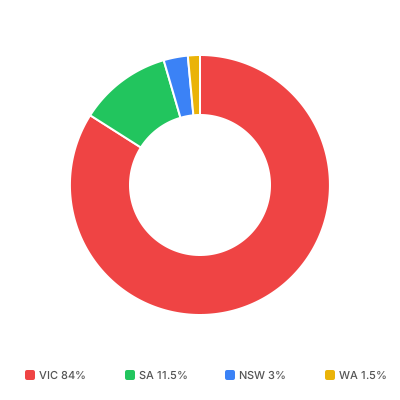
Nashi were introduced to Australia in waves from the early 1980s. Nijisseiki, Shinsui, Chojuro and Tsu Li arrived in 1980, Kosui in 1983, Hosui and a larger batch in 1988, and Shinko in 1990, according to NSW DPI. Early plantings went in at the Orange Agricultural Institute, then the industry spread into Victoria's Goulburn Valley, SA's Adelaide Hills and the Granite Belt. By 2001 Australia had around 500 hectares under nashi, with Nijisseiki the dominant variety, per ISHS (White, 2002). Today Victoria accounts for 84% of production, South Australia 11.5%, NSW 3% and Western Australia 1.5%, per APAL. The Goulburn Valley is the industry's heartland.
Nashi Pear Production in Australia
According to Hort Innovation, Australian nashi production sat at 1,805 tonnes worth $8.0 million at the farm gate in 2024/25, recovering from a low of 877 tonnes in 2019/20 when imports of 2,843 tonnes filled most of the gap. By 2024/25 imports were still 2,720 tonnes, meaning roughly 60% of the nashi on the shelf wasn't grown here. The wholesale value of total supply climbed from $9.9 million in 2018/19 to $23.5 million in 2024/25, driven by demand through Asian grocery stores in Sydney and Melbourne. Per-capita supply is around 0.17 kg per person per year, keeping nashi a niche fruit. Australia exports essentially none of its production. Reducing skin russeting remains the main research challenge identified in international literature, as it affects premium retail placement, per ISHS (White, 2002).