

Pear Season
Pears in season in Australia. Month-by-month availability by state, peak supply windows, growing regions and varieties.
When are Pears in Season?
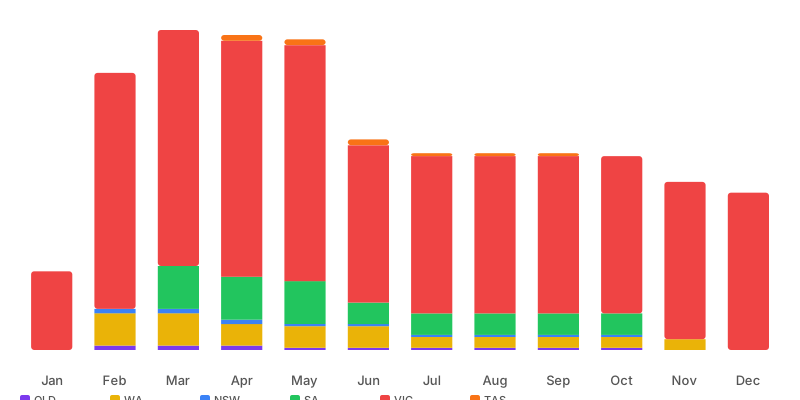
Pears are in season in Australia from late summer through autumn and into winter. Fresh new-crop fruit starts arriving from January, with the bulk of the season peaking between February and May when Goulburn Valley orchards are in full swing. Cold storage extends availability year-round for most major varieties, though the quality gap between new-crop and stored fruit is more noticeable with pears than almost anything else in the fruit bowl.
When is Pear Season in Australia?
Pears are primarily an autumn crop in Australia, with peak supply from February to October.
Pears take four to six years from planting to first commercial crop and are productive for 50 to 75 years. Most orchards graft onto quince rootstock to control tree size. Unlike apples, pears are picked before fully ripe. They ripen from the inside out, and if left on the tree too long they go from firm to mealy at the core, a condition SBS Food calls "sleepy pear." After picking they need a short chilling period before ripening at room temperature. Commercially they go into cold storage and ripen to order. The gentlest ripeness test is to press just below the stem.
Pear Availability by Season
Pear Varieties
Packham dominates at around 60% of Australian production and carries the cold-storage season through to November, while Williams comes in earliest (February to April), Beurré Bosc holds shape under heat and peaks March to June, and Corella is the odd one out. It's a small Barossa Valley variety that many people prefer to eat firm and crunchy.
Pear Varieties Through the Year
Williams Pear Season
Williams (internationally Williams' Bon Chrétien, in the US Bartlett) is the earliest pear of the season, peaking February through April and finishing by May, per Wikipedia. Green skin turns yellow as it ripens, with a sweet, fragrant, almost floral flavour. A large proportion goes to processing, mainly canning, juice, and Poire Williams eau-de-vie. But the fresh window is worth catching. It doesn't store as long as Packham or Beurré Bosc, so don't sit on it once it's on shelves.
Beurre Bosc Pear Season
Beurré Bosc peaks March through June, with new-crop fruit arriving in February and cold-store supply extending into spring. Originally from France or Belgium in the early 1800s (the name means "buttery," after horticulturist Louis Bosc), it has the most distinctive silhouette on shelves. Long tapering neck, russeted cinnamon-brown skin that gives nothing away about ripeness, per Wikipedia. Dense, crisp flesh with a mellow honey flavour. It holds its shape well under heat, making it the standard for poaching. At around 10% of total production it's the third-largest variety by volume, per Australian Farmers.
Corella Pear Season
Corella peaks in April and May, with small volumes from late March and mostly done by July. A smaller pear with golden-yellow to red-blushed skin, its origin is traced to the Barossa Valley, developed from seed brought by German settlers, per SBS Food. Dense, juicy flesh with a slightly tropical quality. One of the few pears worth eating crunchy, and many people prefer it firm. Volumes are small, so it turns up more reliably at specialist greengrocers and farmers markets than at major supermarkets.
Packham Pear Season
Packham is the workhorse of the Australian pear industry, accounting for around 60% of production and available virtually year-round thanks to excellent cold-storage performance, per Australian Farmers. Peak fresh supply runs May through November with the Goulburn Valley crop. Bred in the late 1890s by Charles Packham in Molong, NSW, it's Australia's leading export pear, shipped internationally under the Goulburn River Gold® brand, per Storyplace. Large and often irregular in shape, it ripens from bright green to yellow-green. Slow to ripen and stores hard, which suits supermarket logistics but requires patience from shoppers.
Where do Pears Come From in Australia?
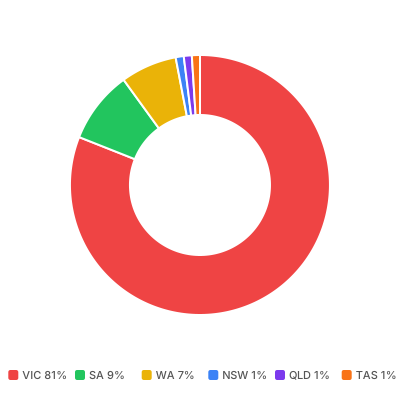
Pears have been grown in Australia since 1788. Victoria's Goulburn Valley produces 81% of the national crop in 2024/25, per APAL, with cool winters and warm summers close to ideal for European varieties. South Australia contributes around 9% (Barossa Valley and Adelaide Hills), Western Australia around 7% (Donnybrook and Manjimup), and Tasmania, NSW and Queensland the rest. Australia's most significant contribution to world pear culture came from NSW. In the late 1890s, Charles Packham of Molong crossed a Bell pear with a Williams and produced what the NSW Agricultural Department's fruit expert declared "without exception the best pear I have ever seen", and Packham's Triumph is now Australia's most popular export pear, per Storyplace.
Pear Production in Australia
APAL Industry Stats show production fell from a peak of around 124,000 tonnes in 2020/21 to 72,223 tonnes worth $112.3 million by 2024/25, while per-capita consumption dropped from 2.44 kg in 2015 to 1.57 kg, roughly one pear per month. Only 59% of households buy pears regularly, compared to 93% for bananas and 84% for apples, per ABC Rural. About 10% of Australia's pear trees were pulled out in 2023 alone. Part of the problem is that pears arrive at supermarkets unripe and hard, and shoppers who don't know to wait often end up with rock-hard or rotten fruit. About 8% of production is exported, mostly Packham under the Goulburn River Gold® brand, with around 80% of Victorian fruit going through the major supermarkets.