

Cherry Season
Cherries in season in Australia. Month-by-month availability by state, peak supply windows, growing regions and varieties.
When are Cherries in Season?
Cherry season in Australia is short, running essentially from late October to late February, with peak supply between November and January. New South Wales and South Australia open the season from mid-October, Victoria and Western Australia follow through November, and Tasmania carries the tail through to late February with the latest fruit of the year. Outside that window any cherry on the shelf is imported, mostly from the United States.
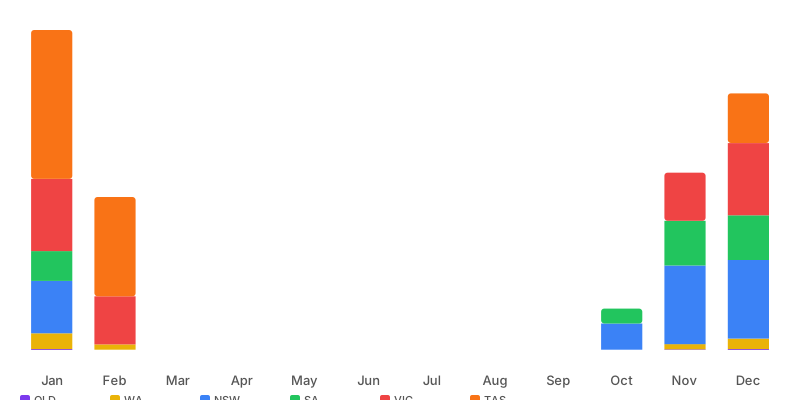
When is Cherry Season in Australia?
Cherries are primarily a summer crop in Australia.
Sweet cherries are the commercial type sold fresh in Australia, requiring significant winter chill below 7°C, which is why production sits in cooler southern Australia and elevated pockets like Stanthorpe and Batlow. Spring bud-burst is extremely frost-sensitive, and December and January rain splits fruit, making cherry season one of the most weather-exposed in the produce calendar. Annual production has swung from around 11,000 tonnes (2016/17) to over 20,000 tonnes (2018/19) on weather alone. Most varieties need cross-pollination, so growers plant blocks of two or three cultivars together with honey-bee hives during flowering. Lapins and Stella are self-fertile exceptions. Modern orchards use open-bush training, UFO trellising, and increasingly rain-covered structures in high-rainfall regions.
Cherry Availability by Season
Where do Cherries Come From in Australia?
Cherries are grown in every state except the Northern Territory, concentrated in the temperate south. Tasmania is the largest producer at 31.4% in 2024/25, with orchards in the Huon Valley, Coal River Valley, Tamar region and Spreyton/Ulverstone. The maritime climate gives the slowest, most flavour-developed fruit of the year. Victoria (25.4%) grows mainly in the north-east, the Goulburn Valley and the Upper Goulburn/Strathbogie hills, with the high Tolmie district running latest into February. NSW (24.9%) splits between the traditional centres of Young and Orange, plus newer plantings in Hillston and Narromine targeting the earliest fruit in the country. SA (14.1%) is centred on the Mount Lofty Ranges and Adelaide Hills. WA (3.9%) concentrates around Bridgetown and Mt Barker, and Queensland's share (0.3%) is essentially symbolic.
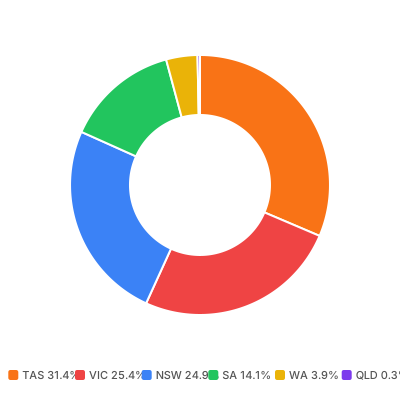
Cherry Production in Australia
Australian cherry growers produced 19,741 tonnes worth $301 million in 2024/25, at about $15 a kilogram at the farm gate, making cherries the country's highest-value fresh fruit by weight, according to Hort Innovation. Cherry Growers Australia puts roughly 350 enterprises across the southern states across around 3,177 hectares. Exports run to about 4,400 tonnes worth $91 million into more than 30 markets. Tasmania produces over half of national exports, with its area freedom for fruit fly opening access to Japan, Korea, Taiwan and China. US imports supply the May-to-November counter-season window.