

Grape Season
Grapes in season in Australia. Month-by-month availability by state, peak supply windows, growing regions and varieties.
When are Grapes in Season?
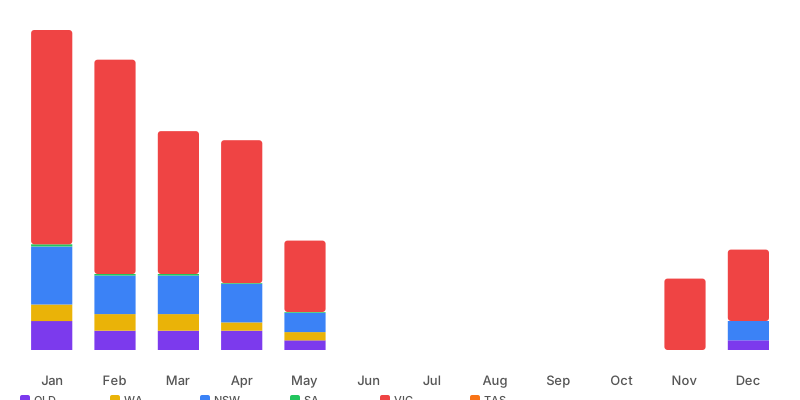
Table grapes are in season in Australia from December through to April or May, with peak supply between January and March when vines across Victoria, New South Wales and Queensland are all producing at once. Outside that window you'll find imported grapes on the shelves, mainly from the United States, Chile or South Africa, though volumes have dropped noticeably as Australian production has grown.
When is Grape Season in Australia?
Grapes are in season across summer and autumn in Australia, with peak supply from January to April.
Table grapes grow on permanent vines that take around three years to reach a first commercial crop. Growers use practices like girdling and gibberellic acid sprays to produce large, firm, well-coloured bunches. The vines need a long, warm growing season, which is why the Murray-Darling Basin (particularly around Mildura and Griffith) accounts for most Australian production, per DAFF/ABARES. Harvest runs from late November in Queensland through to May in cooler Victorian districts. Grapes don't ripen after picking, so variety timing matters. Flame Seedless peaks December to January, while Crimson Seedless and Thompson Seedless run into March and April. By late autumn, what's on the shelf is increasingly imported.
Grape Availability by Season
Grape Varieties
Australian table grape varieties stagger through the summer window. Menindee White and Flame Seedless are earliest (December to January), Black and Midnight Beauty overlap through late December and January, while Crimson Seedless, Red Globe and Thompson Seedless carry the season into April or May.
Grape Varieties Through the Year
Menindee White Grape Season
Menindee White peaks in January and is available from late November to early February. Developed at the Mildura Horticultural Research Station and named after the Menindee Lakes region, it was the dominant white table grape on Australian markets for decades. Large, oval, pale golden-green berries with seeds and thin skin (one of the few seeded varieties still widely grown for fresh eating) with a mild, sweet flavour. It's often the first Australian grape on shelves in summer, per Hort Innovation.
Flame Seedless Grape Season
Flame Seedless peaks December to January and drops off quickly. By February most red seedless on the shelf is other varieties. A US-bred hybrid of Thompson Seedless, Cardinal and several other Vitis vinifera cultivars, it's one of the most widely grown table grapes worldwide, per Wikipedia. Medium-large, bright red, seedless berries with a sweet flavour and good shelf life. Its long growing season suits the Sunraysia and Riverina districts well.
Black Grape Season
Black table grapes cover a range of cultivars grouped under the "Black" category in Australian production data. Available late December through February, deep purple-black skin, typically seedless and sweet, grown across the major Murray-Darling Basin districts. Look for firm, deeply coloured berries with a slight natural bloom (a dusty skin is a good sign, not a bad one), per Hort Innovation.
Midnight Beauty Grape Season
Midnight Beauty is a proprietary seedless black grape variety bred in California and grown commercially in the Sunraysia and Riverina districts, available late December through January. Elongated, deep black-purple berries with crisp texture and notably sweet flavour. Volumes are smaller than major red and white varieties so it tends to appear at premium grocers and farmers markets rather than supermarkets, per Hort Innovation.
Crimson Seedless Grape Season
Crimson Seedless peaks February to March and is available from January through to May in some years, one of Australia's most important export varieties, bred at the USDA research station in Fresno as a late-season alternative to Flame Seedless. Medium-sized, deep crimson-red, seedless berries with firm flesh and a mildly sweet flavour. Its late season and good shelf life make it the variety to look for when other summer fruit has peaked, per Hort Innovation.
Red Globe Grape Season
Red Globe peaks February to April, one of the later and wider-season table grape varieties. Very large, round, deep-red berries with seeds and firm flesh, per Wikipedia. Grown mainly in warm, long-season regions including Australia's Murray-Darling Basin and exported across Asia where the large berry size is valued. Easy to spot on the shelf. Nothing else looks quite that big.
Thompson Seedless Grape Season
Thompson Seedless (also known as Sultana) has the longest season of the common table grape varieties, peaking February to April with availability from January to May. Small to medium, oval, pale yellow-green seedless berries with a neutral-sweet flavour. Not the most exciting fresh grape, but very consistent. It's been the backbone of the Sunraysia industry for over a century. Grown for fresh eating, dried into sultanas and used in juice, most Australian sultana production comes from Thompson Seedless vines around Mildura and Robinvale, per DAFF/ABARES.
Where do Grapes Come From in Australia?
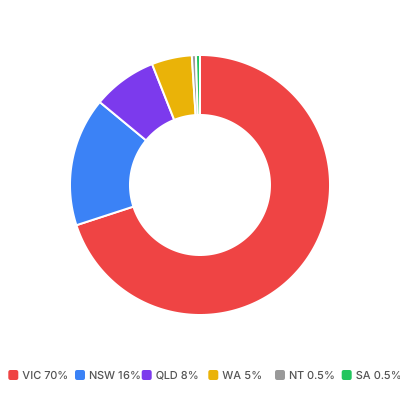
Grapevines came to Australia with the First Fleet in 1788, and commercial table grape growing was established in Mildura in the 1890s after William Chaffey built irrigation infrastructure along the Murray River. The region's hot summers, low humidity and reliable irrigation proved ideal, discouraging the fungal diseases common in wetter climates. Today, according to Hort Innovation, Victoria produces about 70% of Australia's table grapes (almost entirely in Sunraysia), NSW contributes around 16% (mainly Griffith), QLD around 8%, and WA's Swan Valley and Carnarvon plus small NT volumes make up the rest.
Grape Production in Australia
Hort Innovation reports Australian table grape production of 228,882 tonnes worth $874.9 million in 2024/25, with around 140,754 tonnes (worth $578.6 million) exported, predominantly to South-East Asia and the Middle East. Australia exports more table grapes than it keeps for domestic consumption, a reversal that surprises most people. Fresh imports have fallen sharply to 7,986 tonnes in 2024/25 from over 17,000 tonnes a decade earlier as local production scaled up. Victoria dominates at around 70% (concentrated in Sunraysia around Mildura), with NSW at 16% (mainly Griffith) and QLD at 8%. The Murray-Darling Basin accounts for around 80% of irrigated grape production, making water allocation levels in the Basin a direct factor in how much fruit reaches market each season, per DAFF/ABARES.