

Onion Season
Onions in season in Australia. Month-by-month availability by state, peak supply windows, growing regions and varieties.
When are Onions in Season?
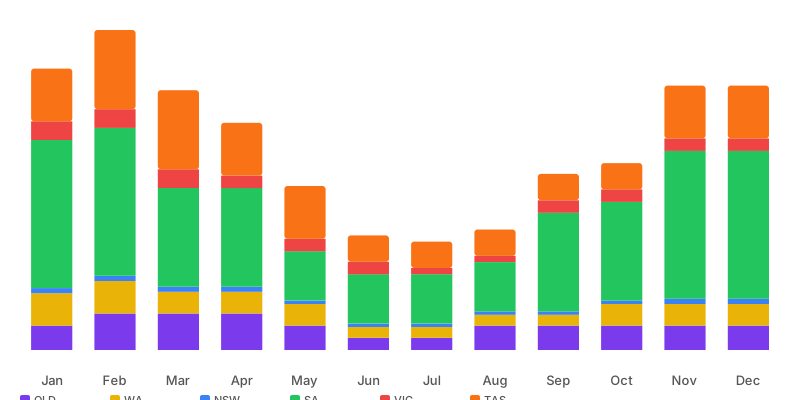
Onions are available year-round in Australia, with the main harvest window running from November through to April when fresh new-season bulbs arrive from South Australia and Queensland. Outside that window the onions on the shelf are typically coming out of cool storage, which keeps quality consistent for most of the year. The leanest period for genuinely fresh product is May to August, when storage stocks are doing the heavy lifting.
When is Onion Season in Australia?
Onions are in season year-round in Australia, with peak supply in summer.
Onions need three to six months from seed to mature bulb, depending on region and the variety's day-length response, per Onions Australia. Autumn is the recommended planting window in most of the country. Onions Australia classifies varieties by day-length requirement. Short-day types (10–12 hours to bulb) are planted in Queensland and northern NSW from February to May, coming off from September. Intermediate-day types cover the southern states south of about 35°, planted May to August and harvested late November to March. Most commercial production uses hybrid seed for uniform bulb size and better disease resistance than older open-pollinated lines.
Onion Availability by Season
Onion Varieties
Brown onions make up around 78% of the crop and are the year-round staple. Red onions are milder and suited to raw use, peaking January to March. White onions are the smallest category and easiest to find at specialty grocers. Shallots and spring onions have a much shorter harvest-to-shelf life and are best bought in small quantities.
Onion Varieties Through the Year
Brown Onion Season
Brown onions are Australia's everyday staple, accounting for around 78% of onion volume and roughly 69% of retail value at retail, per the NRE Tasmania Onion Market Profile. Fresh peak supply runs from November through April from the Adelaide Plains and Queensland. Storage product covers the rest of the year. Look for tight, dry golden-brown skins and firm flesh. Soft necks or sprouting means the bulb is past its best.
Red Onion Season
Red onions peak from January through March and taper to a low from July to August. They account for around 19–24% of retail onion volume and typically sell at a premium over brown onions, per the NRE Tasmania Onion Market Profile. Flavour is milder and sweeter than brown, making them better suited to raw use in salads or light grilling than long cooking, as they lose most of their colour once heated. As Onions Australia notes, they're sometimes incorrectly labelled "Spanish onions" in supermarkets. That name refers to the skin colour, not the origin.
White Onion Season
White onions follow a similar seasonal pattern to red. Fresh supply peaks January to March, with lower availability through mid-winter. They make up only around 2–4% of retail sales and, per Onions Australia, are considered slightly more pungent than brown onions when raw, though milder varieties suit salads and sandwiches well. Popular in Mexican-influenced cooking and Asian cuisines, they're most easily found at good greengrocers and farmers markets rather than supermarket chains.
Shallots/Spring Onions Season
Shallots and spring onions peak from February to April and are available through most of the year, dropping to a low in June and July. They're harvested eight to twelve weeks from planting, much faster than bulb onions, and the Lockyer Valley in Queensland is a key growing region for fresh green shallots. Unlike dry-bulb types, they don't store well once cut or bunched, so buy in small quantities and use within a week. Mild and fresh in flavour, they work best raw or lightly cooked at the end of a dish rather than as a cooking base.
Where do Onions Come From in Australia?
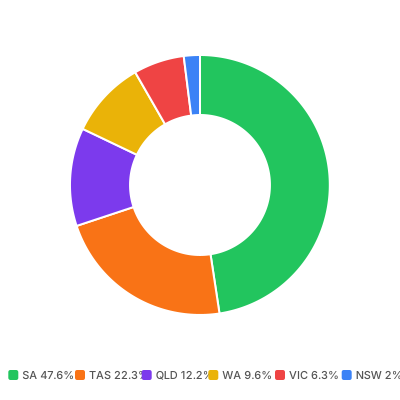
South Australia leads at 47.6% of national output in 2024/25, centred on the Adelaide Plains. Tasmania is second at 22.3%, with growing regions around Forth, Scottsdale, Cressy and Deloraine, per the NRE Tasmania Onion Market Profile. Queensland accounts for around 12.2%, concentrated in the Lockyer Valley and the Darling Downs. Western Australia contributes 9.6% from south-west growing areas. Victoria (6.3%) and NSW (2%) round out the tally. NSW production is concentrated in the Riverina belt from Griffith and Whitton south to Jerilderie (around 90% of the state's crop), per DPI NSW. The staggered geography means domestic supply is spread reasonably evenly across the year rather than clustered in a single peak.
Onion Production in Australia
According to AUSVEG, Australia produces around 250,000 to 270,000 tonnes of onions a year, the country's fourth-largest vegetable crop by volume, worth roughly $290–330 million at the farmgate in recent seasons. Around 380 growers make up the industry, concentrated among a handful of large producers and packers. Hort Innovation puts 2023/24 exports at 45,900 tonnes worth $45.7 million, with Thailand, Taiwan, Malaysia, the UAE and Europe as the main destinations. Tasmania historically sends 45–50% of its crop into export markets, meaning any softness in Asian or European demand pushes prices down domestically. Imports run around 6,000–8,000 tonnes a year.