

Pea Season
Peas in season in Australia. Month-by-month availability by state, peak supply windows, growing regions and varieties.
When are Peas in Season?
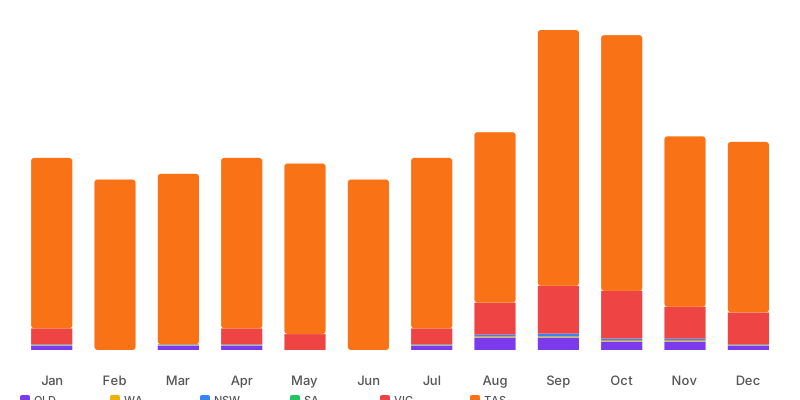
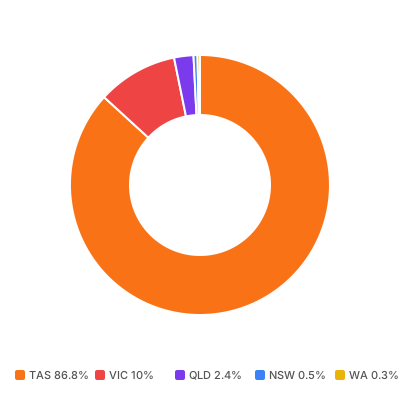
Fresh peas are in season in spring across most of Australia, with the main supply window running from August through November. Tasmania is in a class of its own for volume. The island state accounts for around 87% of our national production and is the sole source of Australia's processed green peas. Snap and snow varieties are available through the warmer autumn months too, before cold winter nights shut them down.
When is Pea Season in Australia?
Peas are primarily a spring crop in Australia, with peak supply from April to January.
Peas are a cool-season crop. Most varieties go from seed to first pod in eight to twelve weeks, sown direct into the ground and trained up a trellis (plants can reach two metres). Commercial processing crops are harvested mechanically by mobile viners in a single pass. Peas fix their own nitrogen through root nodule bacteria, making them a useful rotation crop. They don't tolerate temperatures above 30°C, which causes poor pollination, early maturity and lower yields. The main commercial season sits firmly in late winter and spring, per AUSVEG.
Pea Availability by Season
Pea Varieties
The three pea types on Australian shelves come from quite different supply chains. Garden peas are a Tasmanian-dominated processing crop where the fresh window is short and the frozen version is under import pressure, while snow peas and sugar snaps are mainly a fresh Western Australian product grown near Wanneroo, with eastern states filling the spring window from August to November.
Pea Varieties Through the Year
Garden Peas Season
Garden peas (the shelling type) peak fresh supply in September and October, with the main commercial volumes from Tasmania and Victoria. The processed version follows the same seasonal curve. Peas harvested by vining machines at peak sugar content are immediately frozen or canned. Tasmania is the sole source of Australian-grown processing peas, though Coles's decision to shift its private-label supply offshore means more supermarket freezer peas are now imported, per ABC News. Read the country-of-origin label rather than trusting the brand name.
Snow Peas Season
Snow peas (the flat bright green pod eaten whole) are known as mange-tout in Britain and France, per Wikipedia. In Australia they peak in November, with good supply from August to October. Western Australia, centred on Wanneroo, is the main growing state with year-round production and best quality in spring and autumn. Pods are picked every two days to keep them tender, around eight to twelve weeks after planting, per AUSVEG. Imports from Zimbabwe and South Africa fill the late-winter gap when local WA supply drops off.
Sugar Snap Peas Season
Sugar snap peas are the plump, rounded cousin of the snow pea, eaten whole and picked when the seeds are nearly full size for a sweeter flavour and satisfying crunch. They peak in November alongside snow peas but with thinner supply. In WA they're mainly grown in home gardens rather than commercially, with snow peas taking the bulk of the fresh market, per AUSVEG. Eastern states growers cover the September to November window. Sugar snaps are harvested at about 7.5 cm pod length and can be picked for four to six weeks per planting.
Where do Peas Come From in Australia?
Tasmania dominates green pea production at 86.8% of national volume in 2024/25, with Victoria a distant second at 10%, Queensland around 2.4% and NSW and WA making up the remainder. The cool, moist climate of the northern midlands (Cressy, Longford and Westbury) suits the crop well, per AUSVEG Veggie Stats (2018). Snow peas and sugar snaps follow a different geography. Western Australia grows most fresh snow peas around Wanneroo, north of Perth, with year-round production but best yields in spring and autumn. South-east Australian growers cover the August-to-November spring window, and Queensland extends availability into late autumn, per AUSVEG.
Pea Production in Australia
Hort Innovation records Australia's pea production at around 19,965 tonnes worth $47.9 million in 2024/25, down sharply from a peak of 35,248 tonnes in 2020/21. Cheaper imports from New Zealand, the United States and Belgium have steadily taken freezer shelf space, and in 2024 Coles ended its eight-year supply contract with Simplot, cutting Tasmanian growing contracts by around a third, from 26,000 tonnes to about 17,000 tonnes, per ABC News. Tasmania produces all of Australia's processing peas, so what happens in Tasmanian paddocks shows up directly on freezer shelves. Separate from this, around 285,000 tonnes of broadacre field peas are grown per year in SA and Victoria for export to India and the Middle East as split pea dhal and snack food, per AEGIC 2024. Australia is the world's leading producer and exporter of the Dun type, per GLNC. These broadacre pulse crops are a different category from the green peas sold at the fresh market.