

Asian Greens Season
Asian Greens in season in Australia. Month-by-month availability by state, peak supply windows, growing regions and varieties.
When is Asian Greens in Season?
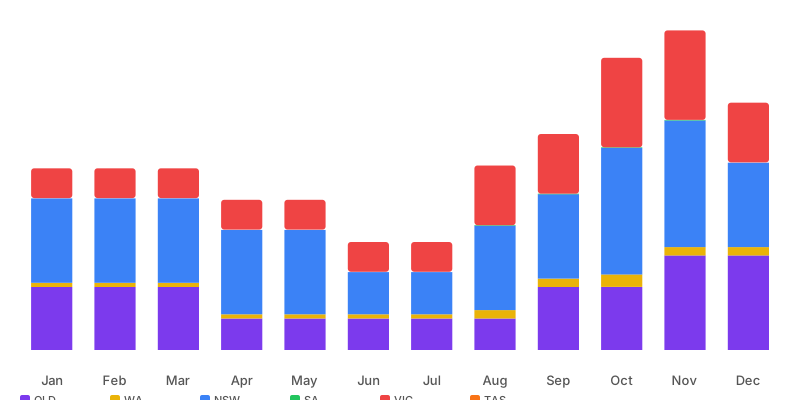
Asian greens are available year-round in Australia, with peak supply running from August through to December when cool-season crops hit their stride across NSW, Victoria and Queensland. The group covers a wide family of Brassica vegetables (pak choy, bok choy, choy sum, gai lan, wombok and baby choy) that differ mainly in stem shape, leaf texture and harvest time rather than growing method.
When is Asian Greens Season in Australia?
Asian Greens is in season across spring and summer in Australia, with peak supply from September to December.
Most leafy Asian vegetables are cool-season brassicas, doing best at 15 to 25°C, so autumn and spring are the main growing windows. According to Sustainable Gardening Australia, pak choy and bok choy are harvest-ready around six to eight weeks from sowing, gai lan takes 60–70 days, and wombok runs longest at roughly 12 weeks. Shallow roots need frequent irrigation. The main commercial pest pressure is diamond-back moth, cluster grubs and aphids, as ABC Gardening Australia notes. In the NT and northern Queensland, the dry season (May to October) is the key growing window, avoiding the humidity that drives disease pressure in the wet.
Asian Greens Availability by Season
Asian Greens Varieties
Pak choy and bok choy are the same species but differ by stem colour. Wombok forms a dense, elongated head and peaks in autumn rather than spring. Choy sum is harvested for its flowering shoots and has the narrowest window. Gai lan is botanically closer to broccoli than to the pak choy group and handles warmer conditions better than most of the others.
Asian Greens Varieties Through the Year
Baby Choy Season
Baby choy is bok choy or pak choy harvested at around three to four weeks, before the plant matures. Supply is steady for most of the year, dipping in January and February when summer heat pressures cool-season brassicas. The small, uniform leaves suit prepacked formats and restaurant use. Staggered plantings keep supply consistent through autumn and winter.
Bok Choy Season
Bok choy (Brassica rapa subsp. chinensis) is one of the most widely grown Asian greens in Australia. As ABC Gardening Australia notes, it has white fleshy stems and dark green leaf blades, distinguishing it from pak choy, which has green stems throughout. Available year-round, it peaks from April through November. Supply pulls back in December and January as summer heat pressures cool-season production.
Choy Sum Season
Choy sum (Brassica rapa var. parachinensis), also known as Chinese flowering cabbage or yu choy, is eaten for its tender flowering shoots before the distinctive small yellow flowers open, as Wikipedia describes. It has thinner stems and a slightly more intense flavour than bok choy. Australian supply dips from February through July. The best window is August through January when NSW and Queensland production lifts.
Gai Lan Season
Gai lan (Chinese broccoli or Chinese kale) is a Brassica oleracea cultivar, putting it in the same species as broccoli, cabbage and cauliflower rather than the pak choy group, as Wikipedia explains. It has thick, glossy blue-green leaves and a flavour stronger and more bitter than broccoli. Broccolini is a hybrid of broccoli and gai lan. Harvested around 60–70 days from sowing, it tolerates warmer temperatures better than most brassicas. Australian supply is relatively steady from March through October, dipping in November and December.
Pak Choy Season
Pak choy shares its classification with bok choy (Brassica rapa subsp. chinensis) but has green stems throughout rather than white, as ABC Gardening Australia notes. Market gardeners consistently cite it as the most popular variety. Peak availability runs from September through February when NSW and Queensland production is strongest, stepping back from March through August. It's well suited to the peri-urban market gardens around Sydney and Brisbane.
Wombok Season
Wombok, napa or Chinese cabbage internationally, forms a dense, elongated head and is the key ingredient in Korean kimchi. The NT Department of Agriculture describes it as Brassica rapa var. pekinensis, thought to be a cross between a warm-climate leafy brassica and a cool-climate turnip, cultivated in China since the 5th century. Australian availability peaks February through May. Supply drops in winter (June–July) and again in spring before recovering in October. Under ideal cold storage it holds for up to two months, extending its retail window.
Where do Asian Greens Come From in Australia?
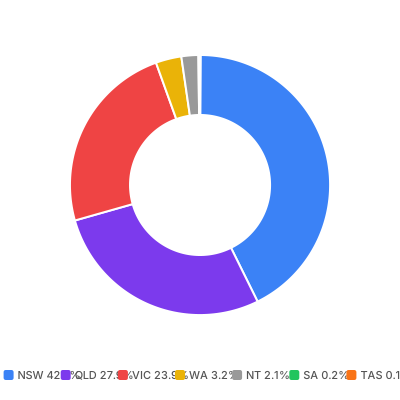
Bok choy, pak choy and choy sum (Brassica rapa subsp. chinensis) have been cultivated in China since at least the 5th century. Gai lan (Brassica oleracea var. alboglabra) is a distinct species, more closely related to broccoli than to bok choy, with origins in southern China. The NT Department of Agriculture notes that wombok (Brassica rapa var. pekinensis) is thought to be a hybrid between a warm-climate leafy brassica and the cool-climate turnip, also cultivated in China since the 5th century. In Australia, NSW leads national production at 42.7%, followed by Queensland (27.9%), Victoria (23.9%), WA (3.2%), the NT (2.1%) and SA and Tasmania making up the remainder, with supply driven by Sydney's market gardens and peri-urban growing areas around Brisbane and Melbourne.
Asian Greens Production in Australia
The ABS Australian Agriculture and Horticulture 2022/23 survey recorded 29,092 tonnes of leafy Asian vegetables worth $91.2 million at the farm gate and $107.3 million at wholesale. AgriFutures Australia traces the industry's growth from approximately $50 million in 1994 to over $135 million in 2002 (a 13% annual growth rate) before the market matured. More recently, the AUSVEG/NielsenIQ Leafy Asian Vegetables Review 2024 found supermarket dollar sales rose 15.6% in the 52 weeks to December 2024, driven mainly by a 14.4% price rise rather than volume (up just 1.0%). Around 40% of households buy leafy Asian vegetables regularly. Fresh exports and imports are both negligible.