

Cucumber Season
Cucumbers in season in Australia. Month-by-month availability by state, peak supply windows, growing regions and varieties.
When are Cucumbers in Season?
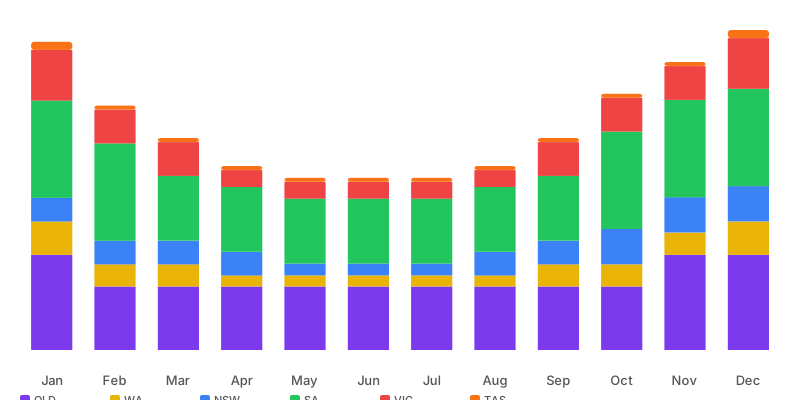
Cucumbers are available year-round in Australia, with peak supply between November and March when warm conditions drive production across Queensland, South Australia and Victoria. Outside that window you can still find them on shelves (especially the continental variety, which benefits from greenhouse growing through winter), but choice narrows and prices tend to firm up. The quietest months are May through July.
When is Cucumber Season in Australia?
Cucumbers are in season across summer and spring in Australia, with peak supply from September to March.
Cucumbers mature quickly. First fruit is ready roughly five to six weeks after planting in warm conditions, with vines producing continuously. Inconsistent watering shows up immediately as misshapen fruit that tapers at one end. Commercial production runs two ways. Field-grown crops dominate in spring and summer, with year-round greenhouse cultivation running alongside. Polythene structures with drip irrigation and nutrient solution allow SA and WA growers to keep continental cucumbers on the market well outside the outdoor season, as the AUSVEG/DAWA guide details. Optimal growing temperatures are 22 to 34°C. Below 14°C growth stalls and fruit quality drops.
Cucumber Availability by Season
Cucumber Varieties
Continental cucumbers are the most consistent year-round option thanks to greenhouse production in South Australia and WA. Lebanese and baby varieties peak November through January and thin out through the quieter winter months.
Cucumber Varieties Through the Year
Baby Cucumber Season
Baby cucumbers peak November through January, with supply dipping from April to October. Essentially a miniaturised continental type, 6 to 10 cm long, smooth-skinned, nearly seedless and mild, they're usually sold in punnets or small bags with skin tender enough to eat without peeling.
Continental Cucumber Season
Continental cucumbers are the largest and most consistent variety on Australian shelves, with high availability October through February and medium availability year-round from greenhouse production. They run 30 to 45 cm long with dark, glossy, slightly ribbed skin and are almost entirely seedless. Compared with field cucumbers, greenhouse-grown continentals have less acid and more sugar, a finer texture and a more tender skin, which is why they're sold individually wrapped, as the AUSVEG/DAWA guide notes. In WA, over 20 growers produce continentals under protected cultivation from Manjimup to Geraldton and Carnarvon, with the best cropping periods August to November and April to May. A well-managed greenhouse plant can produce 30 to 40 fruit over a long-season crop.
Lebanese Cucumber Season
Lebanese cucumbers peak November through January and are least available May through July. They run 14 to 20 cm, glossy-green and mild, with fewer seeds than a continental, and easy to eat whole as a snack. Lebanese migrants brought the variety to Australia from the early 1970s, growing them first in south-west Sydney greenhouses before the variety spread nationally. In greenhouse cultivation, Lebanese varieties are planted closer together than continentals and can carry four to seven fruit per node, making them a higher-yield crop per square metre, though skin damage from wind or rough picking causes bending and unsaleability, per the NT DAF growing note.
Where do Cucumbers Come From in Australia?
The industry as most Australians recognise it today, built around continental and Lebanese varieties in protected cultivation, took shape from the early 1970s, with Lebanese migrants central to the shift. As SBS Arabic reported in 2020, Youssef "Joe" Boustani arrived from Lebanon in 1972 and was among the first farmers to grow Lebanese cucumbers in greenhouse tents in south-west Sydney. At that time, the only cucumber in the market was a slicing variety. Protected cultivation itself is also credited to the Arab-Australian farming community, who brought greenhouse techniques to NSW before the practice spread nationally. The Virginia greenhouse precinct north of Adelaide is now the single most significant cucumber-producing zone in the country.
Cucumber Production in Australia
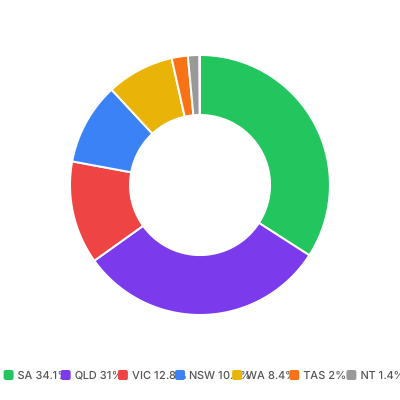
Output reached 113,815 tonnes in 2024/25, up from 84,693 tonnes in 2014/15, with a farm-gate value of $224.9 million, per Hort Innovation. Exports are negligible (69 tonnes in 2024/25) and fresh imports are also minimal. South Australia is the largest producing state at 34.1% of national output, driven by the greenhouse industry at Virginia north of Adelaide. Queensland contributes 31.0% and Victoria 12.8%, with NSW (10.2%), WA (8.4%), Tasmania (2.0%) and the Northern Territory (1.4%) making up the balance, per the ABS. ABC Rural reported in 2024 that Rabobank data showed a 30% spike in consumption among Australians aged 17 to 35, partly linked to viral recipe content on social media.