

Herb Season
Herbs in season in Australia. Month-by-month availability by state, peak supply windows, growing regions and varieties.
When are Herbs in Season?
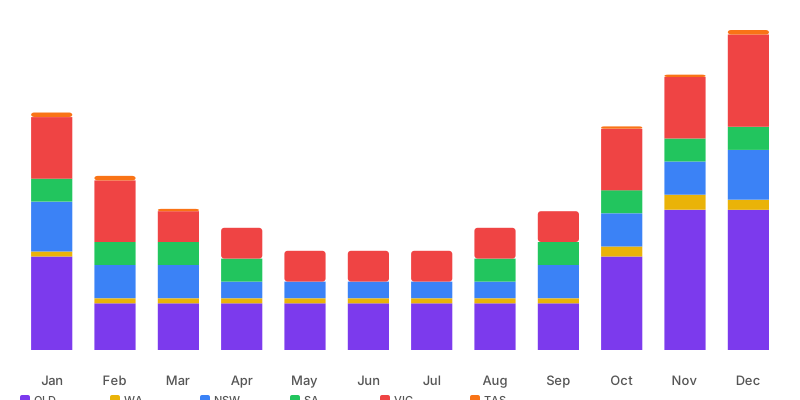
Fresh herbs are available year-round in Australia, with supply peaking October to January when warm-weather varieties are in full swing. Coriander, parsley, mint and basil account for around 80% of the fresh herb industry, per the Tasmanian Institute of Agriculture. These are the four to track through the seasons.
When is Herb Season in Australia?
Herbs are in season across summer and spring in Australia, with peak supply from October to January.
Most supermarket basil or coriander comes from greenhouse systems where the crop turns over in three to six weeks year-round. Larger field operations in South-East Queensland supply open-grown bunched herbs through the cooler months. Shelf life is the industry's main constraint. Fresh herbs last as few as five days without optimal packaging and cold-chain management, per the Tasmanian Institute of Agriculture. Basil is frost-sensitive and needs warmth. Coriander and parsley are cool-season crops that bolt in summer heat. Mint thrives in moist, partially shaded spots. Chives are the hardiest, producing through most of the year across all but the coldest regions.
Herb Availability by Season
Herb Varieties
Basil and coriander have opposite seasonal peaks. Basil is best November to January in warm conditions, while coriander performs best in the cool months from October through April when it doesn't bolt. Mint, chives and parsley sit in between, producing consistently for most of the year.
Herb Varieties Through the Year
Basil Season
Basil peaks November to January when warm nights in Queensland and the NT push field crops to their best. In cooler southern states it typically moves into greenhouse production over winter. Commercial crops turn over in four to six weeks. Sweet (Genovese) basil dominates the fresh market, though Thai basil is increasingly grown for the Asian-ingredients trade. Once chilled it blackens, per Wikipedia, so buy it fresh and use it fast.
Chives Season
Chives are perennial herbs in the onion family and the most forgiving of the commercial five to grow. Supply is steady October through December with only a modest dip through the coldest winter months, per Sustainable Gardening Australia. Garlic chives (Allium tuberosum) are sometimes bundled under the same retail label. Both the leaves and the edible flowers reach shelves from spring through summer.
Coriander Season
Coriander is the biggest-volume fresh herb after parsley, peaking October to January and again in March and April. It thrives in cool to mild conditions and bolts quickly in summer heat, so supply can thin and quality drop through the hottest weeks of January and February, with growers using staggered plantings and shadecloth to extend harvest windows. Seeds and roots are also edible and widely used in South-East Asian and Indian cooking. Cilantro is the US term. Coriander is correct in Australian English, per Wikipedia.
Mint Season
Mint is a spreading perennial that peaks in October and stays available through summer and early autumn before tailing off through winter. It prefers moist, partially shaded conditions and becomes invasive if planted directly in garden beds. Commercial growers keep it in contained rows. Spearmint and peppermint are the main commercial types, though Vietnamese mint and apple mint appear in specialty lines. It tolerates most Australian climates, producing in small quantities across all growing states year-round, per Sustainable Gardening Australia.
Parsley Season
Parsley is the workhorse of the Australian fresh herb category, peaking October through December and holding strong into early autumn. Two types dominate commercially. Curly-leaf holds up well in retail bags, and flat-leaf (Italian) has a stronger flavour and tolerates more variation in conditions, per Wikipedia. Both are widely grown across VIC, NSW, QLD and SA. In subtropical QLD, parsley is often treated as an annual as it can run to seed in its first summer.
Where do Herbs Come From in Australia?
Australia's commercial culinary herbs trace their origins to the Mediterranean basin (parsley, coriander), tropical Africa and South-East Asia (basil), and Europe and western Asia (mint, chives). AgriFutures Australia supported early industry development in the early 2000s, collating technical production data for thirty commercial herb species. Today, Queensland's Lockyer Valley, the Sydney Basin and Melbourne's Yarra and Goulburn valleys are the main fresh-herb production corridors, with basil also coming in volume from the NT and tropical Queensland during winter when southern states drop off.
Herb Production in Australia
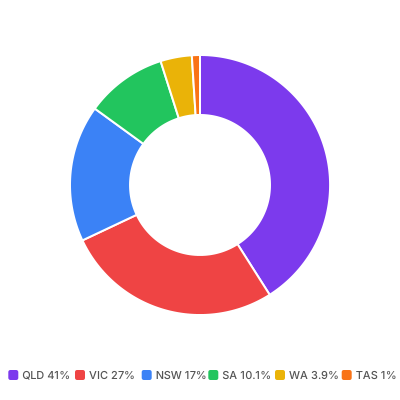
According to Hort Innovation, Australia produced 11,941 tonnes of fresh herbs worth $308.3 million in 2024/25 (wholesale supply value $361.4 million), up from $119.2 million at the farm gate in 2014/15, roughly tripling in value over the decade while production volume held steady at 11,000–12,000 tonnes. Fresh herb exports and imports are both recorded at zero tonnes, reflecting strict biosecurity controls and the product's perishability. Queensland leads at 41% of production (Lockyer Valley and Darling Downs), followed by VIC (27%), NSW (17%), SA (10%), WA (4%) and Tasmania (1%). University of Tasmania trials have shown electrolysed oxidising water treatments can reduce microbial growth on cut herbs, potentially adding days of retail shelf life, per the Tasmanian Institute of Agriculture.