

Lettuce Season
Lettuce in season in Australia. Month-by-month availability by state, peak supply windows, growing regions and varieties.
When is Lettuce in Season?
Lettuce is available year-round in Australia, with the best domestic supply running from October through to March when warm-weather growing regions are at full pace. Victoria and Queensland together account for roughly 80% of the national crop, and the complementary seasons of those two states mean there's rarely a time when the shelves look bare. Winter is the thinner period in southern states, though Queensland's Lockyer Valley keeps production ticking over.
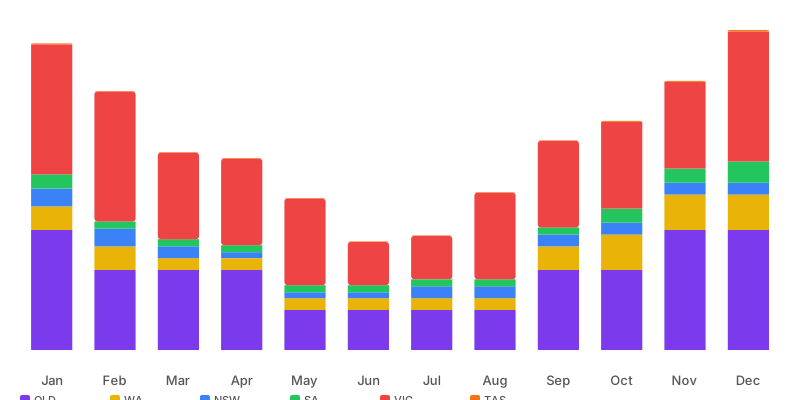
When is Lettuce Season in Australia?
Lettuce is in season across summer and spring in Australia, with peak supply from September to March.
Lettuce is one of the fastest-turning crops in Australian horticulture. From transplanting to cutting a head takes as little as six weeks in summer heat or sixteen weeks in cooler conditions, as Australian Farmers' profile of Koala Farms describes. Growers start seed in a controlled nursery (temperature managed between 3 and 27°C) before transplanting to the paddock. The crop thrives in loose, well-drained soil with a pH between 6.0 and 6.8. Temperature is the main variable, since cool-weather varieties bolt in summer heat while no variety tolerates a heavy frost, per Business Queensland's growing guide. Large operations often plant two varieties side by side during changeover seasons. Seedlings leave the paddock the same day they're harvested, through a vacuum cooler before loading.
Lettuce Availability by Season
Lettuce Varieties
Iceberg dominates by volume and holds up best in transport. Cos runs a close second for crunch and versatility. Oak leaf and butter types are the premium looseleaf options you're more likely to find at farmers markets than in the main chains.
Lettuce Varieties Through the Year
Cos Lettuce Season
Cos (also called romaine) peaks from October through January, when warm-season conditions across Victoria and Queensland suit its need for a long, steady growing run. The upright, elongated head with firm dark-green ribs takes ten to eleven weeks from seed to harvest, a bit longer than iceberg, and outer leaves can be picked progressively while the heart finishes forming, as noted by Sustainable Gardening Australia. That firm texture makes cos one of the more resilient lettuces on the shelf. Supply is available year-round but drops noticeably in autumn and early winter.
Iceberg Lettuce Season
Iceberg is Australia's dominant lettuce variety, peaking October through February and again in spring. Unlike most of the world, where smaller trimmed heads are the norm, Aussie buyers prefer their iceberg big and sold with the outer frame leaves intact, as the Australian Farmers profile of Koala Farms notes. Growing time runs from six weeks in summer to sixteen in cooler conditions. Seeds spend four weeks in a controlled nursery before transplanting. In a normal season, best wholesale is around $50 per box of twelve. The 2022 floods pushed that above $120. Growers turn through six or more varieties across the year to manage heat tolerance and head shape, and heads that don't make the whole-head market get shredded for fast food chains.
Oak Lettuce Season
Oak lettuce, named for the lobed, oak-tree shape of its leaves, is a looseleaf type and the smaller commercial player of the main three varieties. Supply is highest in spring and summer (October to January) and lowest through the cooler months from February to August. It comes in both green and red-leaf forms, and you'll find it most commonly either as a whole loose head or as part of a mixed leaf bag. Oak is more fragile than iceberg or cos and has a shorter shelf life after harvest. At the farm gate it's typically treated as part of the broader "fancy lettuce" or premium leaf category that also includes butter and mignonette varieties.
Butter and Baby Leaf Season
Butter lettuce (also called butterhead or Bibb) is a soft, loosely packed variety grown year-round across Victoria and Queensland. It falls under the broader looseleaf and fancy-leaf groupings in industry data rather than its own tracking category. Baby leaf and mixed salad bags follow the same pattern. Cut-and-come-again production is mostly done in Victoria, with harvest as quick as three to four weeks after transplanting according to ABC Gardening Australia. The bagged salad category has grown substantially since the early 2000s and now makes up a meaningful share of the ABS-reported $688.3 million leafy salad vegetable category nationally (2023/24). Best-before dates on bags are worth following. Pre-cut leaves deteriorate faster than whole heads.
Where does Lettuce Come From in Australia?
Victoria leads at 43% of the national crop, followed by Queensland (36.6%), Western Australia (9.8%), NSW (5.4%), South Australia (4.8%) and Tasmania (0.3%), per the ABS 2023/24. Within Queensland, Business Queensland identifies three main growing districts. The main ones are the Lockyer Valley (autumn through spring), the Eastern Darling Downs (spring, summer and autumn), and the Granite Belt near Stanthorpe. Larger growers like Koala Farms rotate across multiple properties. They move between Darling Downs in summer, Lockyer Valley in winter and Bathurst in NSW for climatic variation.
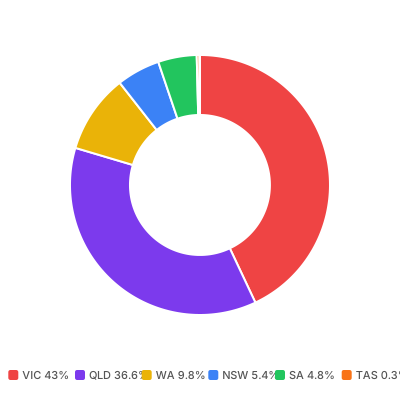
Lettuce Production in Australia
According to the ABS, Australia produced 160,382 tonnes of lettuce worth $275.8 million in 2024/25, up from around 136,000 tonnes worth $168 million in 2014/15 per AUSVEG Veggie Stats. The broader leafy salad category (bagged mixes, baby leaves and spinach alongside head lettuce) was worth $688.3 million nationally in 2023/24. The 2022 flood season showed how exposed the industry can be. Two major floods hit the Lockyer Valley within months of each other, pushing Sydney market boxes above $120 for twelve lettuces. Australian Farmers' profile of Koala Farms reported 200 of the grower's 350 lettuce acres underwater, cutting planting capacity by about a third. KFC swapped lettuce for cabbage in its burgers nationwide. Prices recovered within a season, but the episode underlined how a single weather disruption in southeast Queensland can empty shelves around the country.