

Salad Leaves Season
Salad Leaves in season in Australia. Month-by-month availability by state, peak supply windows, growing regions and varieties.
When is Salad Leaves in Season?
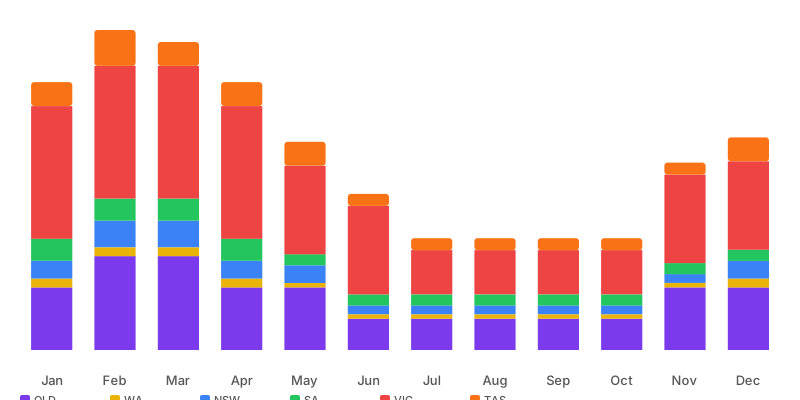
Salad leaves (the pre-washed, ready-to-eat mix of baby spinach, rocket, mizuna and friends) are available in Australian supermarkets year-round. The category is genuinely a 12-month proposition. Commercial growers run complementary farm sites between southeast Queensland and Victoria so that when one region slows down in winter the other picks up the slack. Peak supply runs from January through April, when Victorian and Queensland farms overlap, but you won't struggle to find a bag of mixed leaves in July.
When is Salad Leaves Season in Australia?
Salad Leaves is in season across summer and autumn in Australia, with peak supply from December to May.
Baby salad leaves go from seed to harvest in 25 to 35 days, so a commercial grower can turn a paddock over ten or more times a year. The speed is also the catch. The plants are juvenile and soft, highly sensitive to frost, extreme heat and wet weather, and unsellable if left four or five days past peak harvest. Local Food Connect puts the target germination temperature at around 21°C. Below 10°C germination is unreliable and above 26°C it fails almost entirely. That narrow window is why the industry runs a two-climate model, with Queensland's Lockyer Valley and Darling Downs supplying the cooler months and Victoria's Mornington Peninsula, Werribee and Gippsland corridors handling spring and summer. After cutting, leaves are washed, centrifuged dry and packed under modified atmosphere (elevated CO₂, reduced oxygen) to extend shelf life to around nine or ten days.
Salad Leaves Availability by Season
Where do Salad Leaves Come From in Australia?
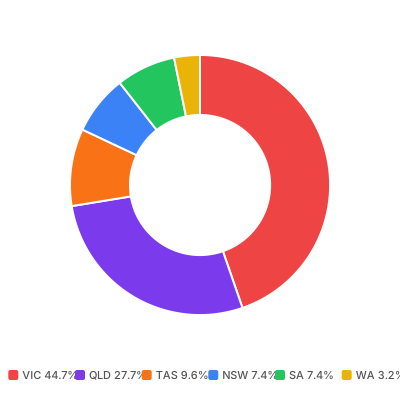
Victoria dominates production at 44.7% of national output, mostly from the Mornington Peninsula and peri-urban areas south and west of Melbourne. Queensland contributes 27.7% from the Lockyer Valley and Darling Downs, Tasmania a meaningful 9.6%, and NSW, SA and WA the remainder. ABC News (2016) describes how commercial operations like Australian Fresh Salads run Victorian sites from August to May and Queensland sites from February to late November, with the overlap covering most of the year. AustralianFarmers (2022) notes that Koala Farms in the Lockyer Valley supplements that model by also running a Bathurst property in NSW, providing a cooler microclimate closer to the Sydney wholesale market.
Salad Leaves Production in Australia
According to Hort Innovation, Australia produced 82,133 tonnes of leafy salad vegetables worth $685.3 million in 2024/25, more than 50% volume growth since 2014/15, driven by bagged and mixed leaves expanding at the expense of whole-head varieties. Baby spinach accounts for roughly 50% of the bagged category by volume, rocket around 20%, with the remaining 30% split between baby cos, mixed blends, and smaller varieties like mizuna and sorrel, according to ABC News (2016). The ABS (2025) put per-capita consumption at 12.5 grams of leaf and stalk vegetables per day in 2023–24, up 5% on the prior year. Exports are modest at 535 tonnes ($4.7 million in 2024/25), mainly to Singapore, Hong Kong and Malaysia. Imports are negligible.